
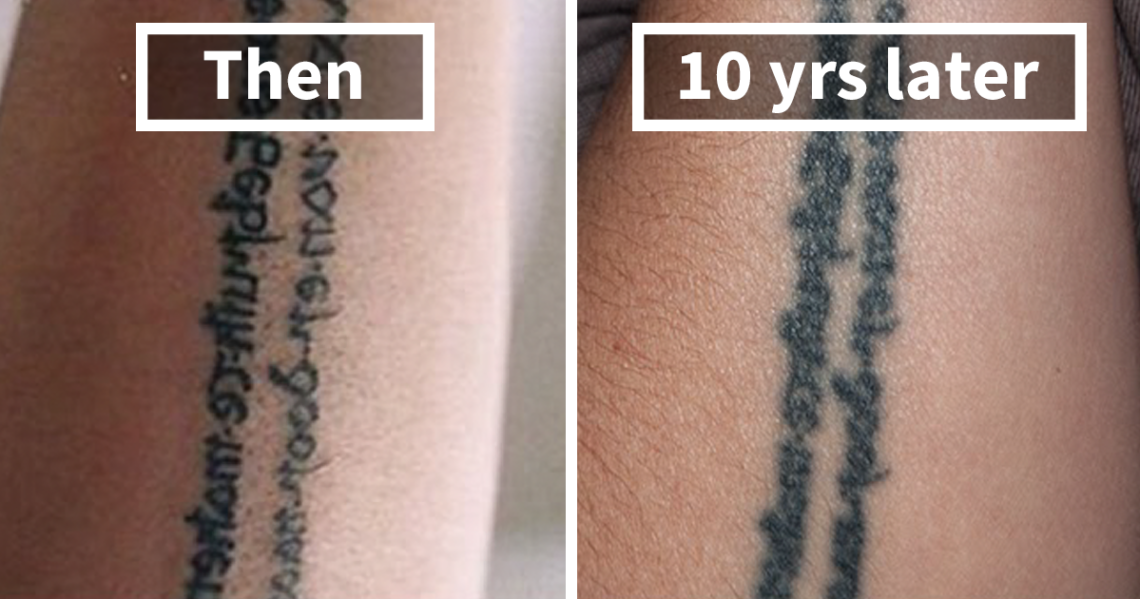
Do fine line tattoos age well? That is the first question most people ask before booking their appointment. And it is a smart question to ask.
Fine line tattoos look absolutely stunning when they are fresh. The thin, delicate lines feel modern and elegant. But what happens in 3 years? In 5 years? In 10 years?
The honest answer is this — fine line tattoos can age beautifully. But only when the right conditions are met. The wrong artist, the wrong placement, or the wrong aftercare routine can turn a gorgeous piece into a blurry smudge within just a few years.
In this guide, you will get the full picture. We spoke with experienced tattoo artists, looked at real healed work, and broke down every single factor that determines whether your fine line tattoo will still look sharp a decade from now — or turn into something you regret.
Let us start from the beginning.
The Short Answer: Yes — But Only Under These Conditions
Fine line tattoos do age well — but they are more demanding than traditional tattoos. They need a more skilled artist, smarter placement, and better aftercare.
Here is the simple truth that most tattoo blogs will not tell you upfront:
Fine line tattoos are not as forgiving as bold, traditional tattoos. A thick black line can lose 20% of its sharpness over 10 years and still look great. A thin, delicate line that loses 20% of its definition can look faded, blurry, or almost invisible.
That does not mean you should avoid them. It means you need to go in with the right information.
The conditions that make a fine line tattoo age well are:
- An experienced artist who specializes specifically in fine line work
- Smart placement on a part of the body that does not stretch or rub constantly
- Proper sun protection starting from day one
- Good moisturizing habits for the rest of your life
- Being realistic about touch-ups as normal maintenance — not failure
If those five things are in place, your fine line tattoo has a very strong chance of looking beautiful for 10 years and beyond.
What Makes Fine Line Tattoos Different From Regular Tattoos (And Why It Matters for Aging)
To understand why fine line tattoos age differently, you need to understand how they are made.
Traditional tattoos use multiple needles grouped together. The artist goes over the same area multiple times. The ink is packed in thick and deep into the dermis — the second layer of skin that sits beneath the surface. Because the ink is packed in densely, it holds for decades with very little care.
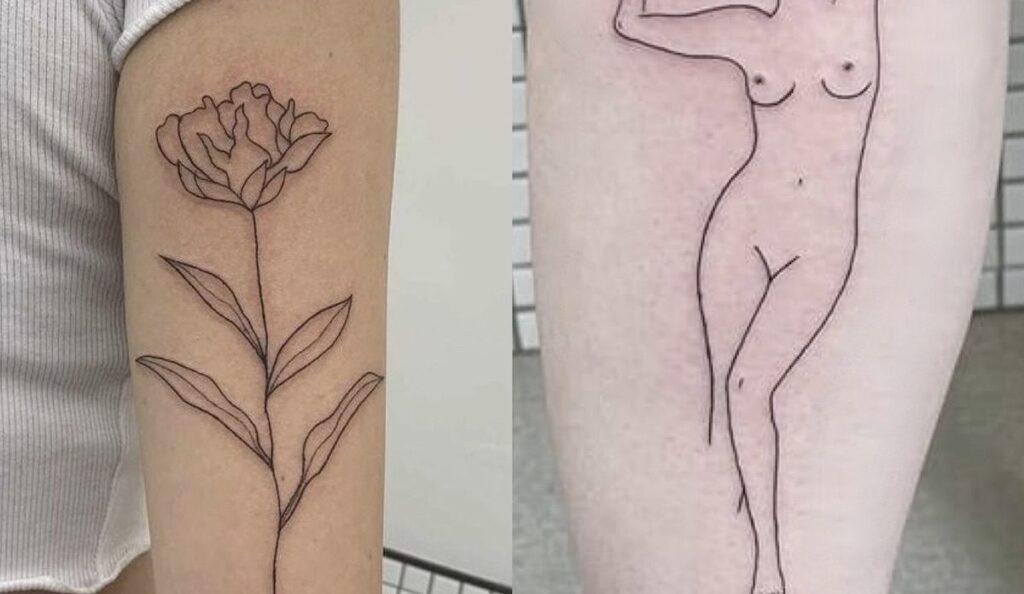
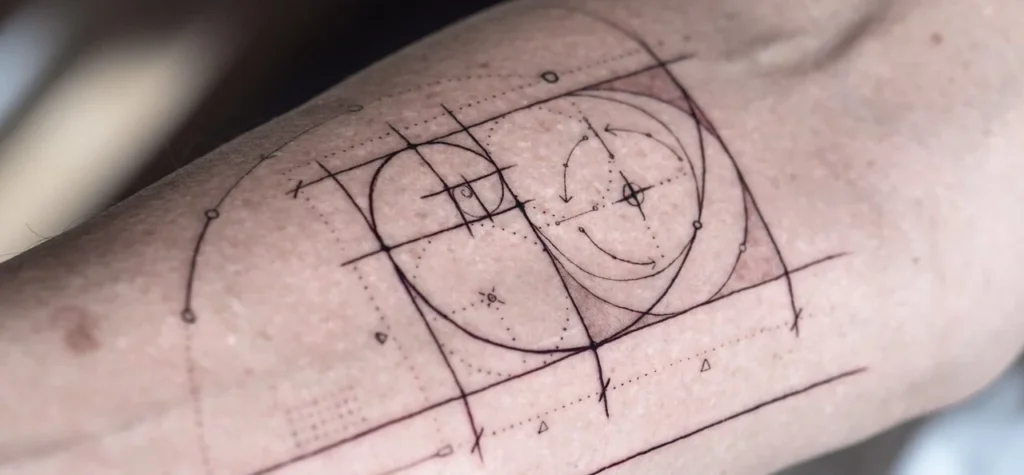
Fine line tattoos use a single needle — sometimes called a single needle tattoo or micro tattoo. The artist makes one clean, precise pass. The lines are thin, the ink is deposited in smaller amounts, and the application is more shallow compared to traditional work.
This difference has a big impact on aging:
| Feature | Fine Line Tattoo | Traditional Tattoo |
|---|---|---|
| Needle type | Single needle | Multiple grouped needles |
| Ink amount | Less ink, lighter deposit | More ink, heavier deposit |
| Ink depth | More shallow | Deeper into the dermis |
| Initial look | Delicate, soft, detailed | Bold, vibrant, strong |
| Fading speed | Faster if not cared for | Slower, more forgiving |
| Touch-up needs | Every 3–5 years typically | Every 5–10 years typically |
| Artist skill required | Very high | High |
Because the ink is deposited in smaller amounts, natural skin turnover — the process where your skin cells replace themselves every 28 to 40 days — gradually pushes ink particles toward the surface over time. With less ink to begin with, this process has a bigger visual impact on fine line work.
This is not a flaw. It is just the nature of the style. And once you understand it, you can plan accordingly.
How Fine Line Tattoos Age Year by Year
One thing almost no other article gives you is a real timeline. Let us fix that. Here is what you can realistically expect at each stage of your fine line tattoo’s life.
Year 1 — The Honeymoon Phase
This is the best your tattoo will ever look — and also the most misleading phase.
Right after your tattoo heals (usually 2 to 4 weeks after your session), the lines will look crisp, clean, and exactly how you imagined. The ink will appear dark and sharp.
During the first year, very little visible change happens. You might notice the lines soften ever so slightly as the skin fully settles. Some people describe healed fine line tattoos as looking like they were drawn with a fine pen rather than a marker — and that is perfectly normal.
What to do in Year 1: Establish good habits now. Wear SPF sunscreen on your tattoo whenever it is exposed to sun. Moisturize daily. This first year sets the foundation for the next decade.
Years 3–5 — When the First Changes Appear
This is the stage where you will notice the first real signs of fine line tattoo aging. The lines may soften. Some areas may appear slightly lighter. If you had very thin hairline details or delicate shading, those elements are often the first to show fading.
If your tattoo was placed on a high-movement area — like your fingers, hand, or inner elbow — you may notice blurring starting around this time. The constant bending and friction accelerates the breakdown of the ink.
If your tattoo was placed in a good location — like your upper arm, calf, or shoulder blade — it likely still looks very good at this stage with only subtle softening.
This is also the stage where many people consider their first touch-up. A touch-up at Year 3 to 5 is completely normal and does not mean anything went wrong. Think of it the same way you think of getting a haircut — it is maintenance, not a repair.
Years 5–10 — What Real Aging Looks Like
By the five to ten year mark, fine line tattoo aging is clearly visible — but that does not mean the tattoo looks bad.
Well-maintained fine line tattoos at the 10-year mark often look like a softer, more vintage version of the original. The lines are still there, still readable, still beautiful — but they have a faded, slightly blurred quality that many people actually find more charming than the razor-sharp fresh version.
Poorly maintained tattoos — those that were left in the sun, never moisturized, placed on bad areas, or done by an inexperienced artist — can look significantly worse. Lines may have spread or bled into each other. Some details may have vanished entirely.
The difference between a great-looking 10-year-old fine line tattoo and a terrible-looking one almost always comes down to those same five conditions we mentioned at the start: artist skill, placement, sun protection, skin care, and touch-ups.
The 6 Biggest Factors That Decide How Well Your Fine Line Tattoo Ages
1. Artist Skill and Needle Technique
This is the single most important factor. More important than placement. More important than aftercare. More important than anything else.
Fine line tattooing requires a level of precision that many tattoo artists simply do not have. The artist needs to know exactly how deep to place the ink. Too shallow, and the tattoo will fade in months. Too deep, and the ink will bleed outward under the skin — this is called a tattoo blowout, and it turns thin, precise lines into blurry, spreading marks that cannot be fixed without a cover-up.
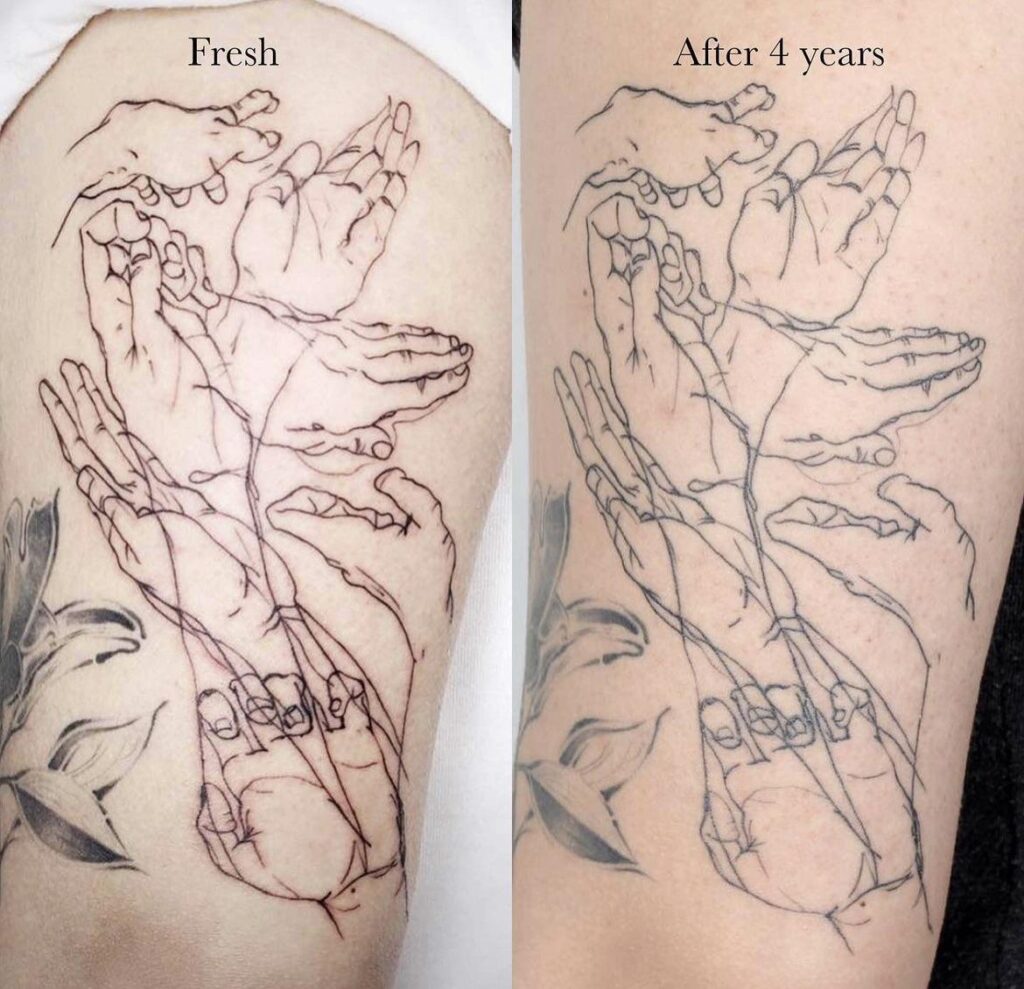
When looking for a fine line tattoo artist, always ask to see healed work — not just fresh photos. Fresh tattoos always look good. Healed photos from two to five years ago tell you the truth about how well that artist’s work holds up.
2. Where on Your Body You Place It
Placement is the second biggest factor in fine line tattoo longevity. The wrong spot can undo even the best artist’s work.
Best placements for longevity:
- Upper arm and forearm (outer side)
- Shoulder blade and upper back
- Rib cage (less sun exposure)
- Calf and upper thigh
- Sternum (if not heavily exposed to sun)
Worst placements for longevity:
- Fingers and knuckles (constant movement and friction)
- Hands and wrists (frequent washing and bending)
- Feet and toes (friction from shoes, constant movement)
- Inner elbow and behind the knee (constant folding)
- Neck (sun exposure and movement)
High-friction zones and high-movement areas break down fine line ink faster than almost anything else. A fine line tattoo on the finger may need touching up every 12 to 18 months. The same design on the upper arm may go 4 to 6 years before needing any work.
3. Sun Exposure and UV Damage
Ultraviolet rays from the sun are the silent enemy of every tattoo — but they hurt fine line tattoos more than any other style.
Here is why: UV rays break down tattoo ink particles under the skin. With a traditional bold tattoo, the heavy ink deposit means there is plenty of pigment left even after UV damage. With a fine line tattoo, the small amount of ink means UV damage has a much more visible effect, much faster.
A fine line tattoo that is regularly exposed to sun without protection can show significant fading in as little as 2 years.
Simple sun protection rules for your tattoo:
- Apply SPF 30 or higher sunscreen on your tattoo any time it will be in the sun
- Reapply every 2 hours outdoors
- Cover the tattoo with clothing when possible during prolonged sun exposure
- Avoid tanning beds entirely
This one habit alone can add years to your fine line tattoo’s life.
4. Your Skin Type and Skin Age
Your own skin plays a big role in how well your fine line tattoo ages — and this is something you cannot fully control, but you can work with.
Oily skin tends to push ink out faster. The excess sebum (natural skin oil) can cause the lines to blur or soften more quickly, especially during the healing process. Artists who specialize in fine line work on oily skin often go slightly deeper to compensate.
Dry skin is more prone to cracking and flaking, which can pull ink out during healing if not properly moisturized.
Aging skin naturally loses collagen and elasticity over time. As the skin becomes less firm and stretches more easily, fine lines in a tattoo can spread or distort — especially in areas where the skin moves and folds. This is a natural process and not something to fear, but it is worth knowing if you are getting a fine line tattoo later in life.
Skin tone also matters. Fine line tattoos on darker skin tones may appear less high-contrast, and some lighter ink colors may not show up well. Black ink holds the best visibility across all skin tones over time.
5. Ink Quality
Not all tattoo ink is equal. High-quality inks are formulated to hold their pigment in the dermis for longer, resist UV breakdown better, and maintain their color depth as the skin ages.
Cheap or low-quality inks can fade dramatically within the first year. For fine line tattoos where the ink amount is already small, starting with inferior ink is a serious risk.
Always ask your artist what brand of ink they use. Reputable fine line artists use professional-grade inks specifically chosen for their precision work. If an artist seems offended by the question or cannot answer it, that is a warning sign.
Black ink is always the most durable choice for fine line tattoos. It maintains the best contrast against skin as it ages, and it fades to a softer grey-blue tone that many people find naturally beautiful. Colored inks — especially pastels, whites, and light pinks — fade much faster and often need touch-ups twice as frequently.
6. Aftercare Habits
What you do in the weeks and years after getting your tattoo has a massive impact on how it ages.
Short-term aftercare (first 4 weeks):
- Keep the tattoo clean and dry during healing
- Apply a thin layer of fragrance-free moisturizer 2 to 3 times per day
- Do not pick, scratch, or peel any flaking skin
- Stay out of direct sunlight
- Avoid swimming pools, oceans, and soaking baths
Long-term aftercare (rest of your life):
- Moisturize the tattoo area daily — well-hydrated skin holds ink better
- Apply SPF sunscreen whenever the tattoo is exposed to sun
- Avoid over-exfoliating the tattooed skin — harsh scrubs and chemical exfoliants accelerate fading
- Stay hydrated and maintain healthy skin overall
Best and Worst Body Placements for Fine Line Tattoo Longevity
Here is a full placement guide so you can make the best decision before booking your appointment.
| Body Area | Longevity Rating | Why |
|---|---|---|
| Upper arm (outer) | ⭐⭐⭐⭐⭐ Excellent | Low movement, less sun if covered, good skin thickness |
| Shoulder blade | ⭐⭐⭐⭐⭐ Excellent | Protected by clothing, minimal friction, stable skin |
| Calf | ⭐⭐⭐⭐ Very Good | Thick skin, moderate sun exposure, manageable movement |
| Upper thigh | ⭐⭐⭐⭐ Very Good | Rarely in direct sun, covered mostly |
| Forearm (outer) | ⭐⭐⭐ Good | Moderate sun exposure, needs consistent sunscreen |
| Chest / sternum | ⭐⭐⭐ Good | Low movement, but sunscreen needed in summer |
| Ribs | ⭐⭐⭐ Good | Covered mostly, but skin moves with breathing |
| Inner arm | ⭐⭐ Fair | Softer skin, some blurring risk over time |
| Wrist | ⭐⭐ Fair | Frequent movement, constant washing — fades faster |
| Foot / ankle | ⭐ Poor | Constant friction, shoe pressure, poor ink retention |
| Fingers / knuckles | ⭐ Poor | Worst placement for longevity — needs frequent touch-ups |
| Inner elbow | ⭐ Poor | Constant folding causes rapid line blurring |
What Real Tattoo Artists Say About Fine Line Tattoo Aging After 10 Years
This is the section that most other articles completely skip — and it is the most valuable information you can get.
Experienced fine line tattoo artists who have been doing this for 10 or more years have seen their own work age in real time. Here is what they consistently say:
On artist skill: Veteran artists are clear that the number one reason fine line tattoos fail is not the style itself — it is artists who are not trained properly in single needle technique. An artist who learned fine line work two years ago by watching YouTube videos will produce very different results from someone who has spent a decade refining their hand pressure, needle angle, and ink depth. The difference in how the work ages is enormous.
On touch-ups: Artists who have been tattooing for 10 or more years almost universally say that clients who come in for regular touch-ups — roughly every 3 to 5 years — have tattoos that still look stunning at the decade mark. The clients whose tattoos look rough are almost always people who never came back for any maintenance.
On placement: Experienced artists will often push back when a client requests a fine line tattoo on the fingers or hands. Many artists will decline to tattoo fingers with fine line work entirely — not because they cannot do it, but because they know the honest truth: the tattoo will not look the same within 18 months, and the client will be disappointed. A good artist protects you from bad decisions.
On colored ink: Fine line tattoo specialists consistently warn against using light colors for fine line work if longevity is a priority. White ink is particularly problematic — it often turns yellow or disappears entirely within a few years. Artists recommend sticking to black ink for anything you want to look good long-term.
On sun damage: Artists say the clients with the worst-aged tattoos are almost always those who spend a lot of time outdoors without protection. Sun damage is irreversible — once the ink breaks down from UV exposure, the only fix is a touch-up or cover-up.
Fine Line Tattoo vs. Traditional Tattoo — Which Ages Better?
Let us settle this comparison properly, because it comes up in every conversation about fine line tattoo longevity.
| Category | Fine Line Tattoo | Traditional Tattoo |
|---|---|---|
| Fresh look | Ultra-detailed, delicate, modern | Bold, vibrant, high-contrast |
| Aging at 5 years | Softer, may need touch-up | Still solid, minimal change |
| Aging at 10 years | Noticeably softer, may blur slightly | Faded but still bold and clear |
| Touch-up frequency | Every 3–5 years | Every 5–10 years |
| Error visibility | High — mistakes show easily | Lower — bold lines mask errors |
| Artist skill needed | Very high precision required | High, but more forgiving |
| Sun sensitivity | Very high | High |
| Best for | Minimalist, detailed, elegant designs | Bold imagery, full sleeves, classic styles |
The honest conclusion: Traditional tattoos age more predictably and require less maintenance. Fine line tattoos require more care but offer an aesthetic that traditional tattooing simply cannot replicate — the delicate linework, the minimalist beauty, the almost sketch-like quality that many people love.
Neither style is better overall. They are different tools for different goals. The key is going in knowing what each one demands.
When Should You Get a Touch-Up? (And What to Expect)
Touch-ups are not a sign that something went wrong. They are a completely normal part of fine line tattoo ownership.
Here is a simple guide for when to book your touch-up:
- 12 to 18 months: If your tattoo was placed on the hands, fingers, or feet, expect to need a touch-up within this window — possibly sooner
- 2 to 3 years: If you notice the lines have softened significantly, some gaps have appeared, or detailed areas look lighter than the rest — it is time
- 3 to 5 years: This is the ideal window for a first touch-up for most fine line tattoos in good placements. The tattoo is fully settled, the healing is long done, and the artist can see exactly what needs refreshing
- 5 to 7 years: If you have maintained your tattoo well with sunscreen and moisturizing, you might not need anything until this point
What to expect at a touch-up appointment:
The artist will go back over the areas that have faded or softened. For fine line work, this typically means re-tracing the lines, filling in any gaps, and refreshing any shaded areas. A touch-up session is usually shorter than the original appointment and costs less — though prices vary by studio.
Touch-up costs typically range from $50 to $200 depending on the size and complexity of the work, and the studio’s pricing.
How to Make Your Fine Line Tattoo Last as Long as Possible
Here is your complete, simple aftercare guide. Follow this and your fine line tattoo will have the best possible chance of aging beautifully.
Week 1–2 (Fresh Healing):
- Gently wash the tattoo with fragrance-free soap twice a day
- Pat dry with a clean paper towel — never rub
- Apply a thin layer of fragrance-free lotion or tattoo-specific ointment
- Wear loose clothing over the tattoo
- No swimming, soaking, or submerging in water
- No direct sunlight on the fresh tattoo
Weeks 3–4 (Late Healing):
- Continue moisturizing twice daily
- Tattoo may look slightly dull or patchy — this is normal during the peeling phase
- Still no direct sun exposure
- Do not pick any flaking skin — let it fall off naturally
Month 2 Onward (Long-Term Care):
- Apply SPF 30+ sunscreen on the tattoo whenever it will be in the sun — every single time
- Moisturize the tattooed skin daily as part of your normal skincare routine
- Avoid harsh exfoliants (strong scrubs, AHA/BHA acids) directly on the tattoo
- Stay hydrated — skin that is well-hydrated from the inside holds ink better
- Schedule a touch-up assessment every 2 to 3 years
Products that help:
- Fragrance-free daily moisturizer (CeraVe, Lubriderm, or similar)
- SPF 50 mineral sunscreen for tattoo areas
- Tattoo-specific balms for the healing phase (Hustle Butter, After Inked)
Red Flags to Watch for When Choosing Your Artist
This is the section no competitor covers — and it could save you from a tattoo you regret.
Choosing the wrong artist is the fastest way to end up with a fine line tattoo that ages terribly. Here is exactly what to watch for:
🚩 They only show fresh tattoo photos. Any artist can make a tattoo look great the day it is done. Ask specifically for healed photos — 2 to 5 years after completion. If they cannot provide any, walk away.
🚩 They have no specialization in fine line work. Fine line tattooing is a separate specialization. An artist who does everything — bold traditional, watercolor, realism, and fine line — may not have the precise needle control that fine line work demands. Look for artists whose portfolio is primarily fine line and single needle work.
🚩 They do not discuss placement honestly. A good artist will tell you if your chosen placement is risky for longevity. If an artist never brings up placement concerns, they may be more focused on taking your money than protecting your long-term result.
🚩 They cannot tell you what ink they use. Professional fine line artists know and stand behind their ink. If they shrug off the question, that is a red flag.
🚩 Their pricing seems unusually low. Fine line tattooing takes longer, requires more precision, and demands more skill than many other styles. Artists who charge far below market rate are often cutting corners somewhere — whether in time, ink quality, or technique.
🚩 They rush the consultation. A great fine line artist will spend time discussing your design, your skin type, your placement, and your lifestyle before touching a needle to your skin. If the consultation feels rushed or skipped entirely, that is a warning sign.
🚩 No visible healed work on difficult skin tones. If you have a medium, dark, or olive skin tone, ask to see healed fine line work on similar skin tones. Fine line tattooing on darker skin requires additional skill and experience. Not every artist has it.
Frequently Asked Questions
Do fine line tattoos fade faster than regular tattoos?
Yes, fine line tattoos do tend to fade faster than traditional bold tattoos — but not dramatically so when properly cared for. The reason is simple: fine line tattoos use less ink and shallower placement, giving natural skin turnover more opportunity to affect the ink over time. A traditional tattoo with heavy ink packing can look relatively unchanged for 10 years. A fine line tattoo in the same timeframe will show more softening — but that softening can still look beautiful with the right care and occasional touch-ups.
How long do fine line tattoos last before a touch-up?
It depends on placement and care. On good placements like the upper arm or shoulder blade, with regular sunscreen use and moisturizing, most fine line tattoos last 3 to 5 years before a touch-up feels beneficial. On poor placements like fingers or feet, you might need a touch-up within 12 to 18 months. Touch-ups are a normal, expected part of fine line tattoo ownership — not a sign of failure.
What does a fine line tattoo look like after 10 years?
A well-maintained fine line tattoo at 10 years looks softer and more vintage than the original, but still clear, still readable, and still beautiful. The lines will have lost some of their razor sharpness and may have a softer, slightly blurred quality. A poorly maintained fine line tattoo — especially one left in the sun regularly or placed on a high-movement area — can look significantly faded, blurry, or patchy at the 10-year mark. The difference is almost entirely down to care and placement.
Do fine line tattoos age well on dark skin?
Fine line tattoos can absolutely age well on dark skin, but they require an artist with specific experience tattooing darker skin tones. The main challenge is contrast — fine lines on deeper skin tones may not appear as high-contrast as on lighter skin, and some ink colors simply will not show up well. Black ink is the best choice for dark skin tones as it provides the most visible, long-lasting contrast. Always ask to see healed examples of the artist’s fine line work on skin tones similar to yours before committing.
Are fine line tattoos worth getting long-term?
Yes — with the right mindset. If you go in expecting a low-maintenance tattoo that will look exactly the same forever, you may be disappointed. But if you go in understanding that fine line tattoos are a style that requires a skilled artist, smart placement, consistent care, and the occasional touch-up — they are absolutely worth it. They offer a level of delicate, minimalist beauty that no other tattoo style can match, and when well cared for, they age with a natural grace that many people find even more appealing than the fresh version.
Conclusion
Do fine line tattoos age well? The answer is yes — and now you know exactly what that yes depends on.
Fine line tattoo longevity comes down to six things: your artist’s skill, your placement choice, sun protection, your skin type, ink quality, and your long-term aftercare habits. Get those six things right, and your delicate linework has every reason to look beautiful for a decade or more.
The biggest takeaways from this guide:
- Fine line tattoos age differently from traditional tattoos — not worse, just differently
- The artist you choose matters more than any other single factor
- Always ask to see healed work before booking — fresh photos tell you nothing about longevity
- Sun protection is non-negotiable if you want your fine line tattoo to last
- Touch-ups every 3 to 5 years are normal, expected, and a small price for ink you love
- Fingers, hands, and feet are the worst placements — upper arm, shoulder, and calf are the best
- Black ink always outlasts colored ink in fine line work
The single biggest mistake people make is choosing an artist based on beautiful fresh photos without ever checking how that artist’s work holds up over time. The second biggest mistake is skipping sunscreen. Fix those two things and you are already ahead of most people walking into a tattoo studio.
Your fine line tattoo can be a piece of art that grows more beautiful with age — like a well-worn photograph, soft around the edges but full of meaning. All it takes is the right choices from the start.

